After the harvest...till being served in your glass.

Usually the young Port wines are kept in Quinta dos Avidagos, our vinification center (located in Alvações do Corgo, close to Régua - the Douro valley) for their first winter before being brought down the Douro river, where the lower temperatures and higher humidity is better for the Port´s maturation.

In our Cellars with 10,000 square meters, the Port matures in very old seasoned oak casks called pipas (pipes).
During this amazing aging process it will be tasted regularly by our winemakers or oenologues, to assess its quality.

Our Ports will gradually mellow in an oxidative process "angels share", with this process (Tawny Port) we are losing about 2% to 3% of Port annualy, achieving a nutty and amber hue and an incredible taste based in dry fruits shell, toffee, cigar box, coffee, stewed figs, bitter chocolate hints... softness and an elegant delayed after taste.

Since 1862 that C. da Silva, a traditional Port wine House, has been driven by the ambition of presenting the higher quality, namely for the "Colheita" and Aged Tawnies.

Devotion and passion a full time commitment

The Aged Tawny matures in oak for long and variable periods of time, in which the age indicated on the label corresponds to the approximate average of several Colheita Port wines in the blend.
Highlighting its long aging in seasoned oak, the Tawny with thirty or over fourty years old will present a golden color with greenish tints, evolving, reaching a bouquet which brings out the very complex aroma.

Depending on the desire to preserve Port´s longevity in the bottle, or for immediate consumption, it is very important to know the temperature range, bottling date and recommended storage period after opening.

Above all, you should not feel shy and do it relaxed when it comes the time to enjoy the extraordinary range of DALVA´s Port wines.

Gonçalo Devesas

C. da Silva / DALVA´s Golden path

The uniqueness of the Golden Whites has started long time ago with the Imperial White Port - Special Reserve Vintage 1917.


The last oak cask of a myth - DALVA Golden White 1952

C. da Silva has carried the seal of long time supplier to the Royal House, therefore the reason of the word "Imperial" in the label of the very old Ports that emerged in the first two decades of the twentieth century.

Ageing White Port wines from a single harvest in small french oak casks has been since the very beginning our devoted quest for a distinctive Port.

It was the reputation of this wines, DALVA Golden White 1952 and recently the DALVA Golden White 1963, that made C. da Silva an internationaly recognized Port Company, wich has earned several and prestigious prizes.

The first DALVA White Colheita harvested in 1917
Blended and single harvest Port wines ageing permanently in 2900 seasoned french oak casks, with about 250 to 730 liters, till their bottling date.

Currently the Golden White path is a very serious and long commitment for the dedicated staff and the passionated management, recognized worldwide since 2005, with more surprises to come when we just reached less than 400 liters of the liquid gold.

DALVA Golden White 1952

No no... you may take a deep breath, the DALVA Golden White 1952 will not be bottled in a flask.

Since the very beginning the main goal of this traditional Port wine Company was, is and will be, to conquer a market of authentic and unique Port.

Gonçalo Devesas

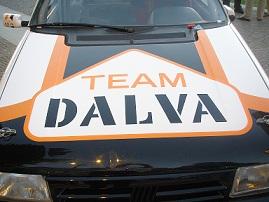
TEAM DALVA...recovering traditions.

DALVA´s cocktail party at the river front
2th of June 2011… at the sunset, in the riverfront, near to C. da Silva wine shop, we promoted a cocktail party with the DALVA Dry white and the Rosé, for the TEAM DALVA.

C. da Silva is sponsoring a racing team in the Fiat Uno national championship.

DALVA´s racing car
Motor racing has been a family (C. da Silva) tradition since the late sixties...

Clemente Ribeiro da Silva (Mr. C. da Silva´s son) was born in 1943, a very creative person, he revealed since his youth a innate ability to draw, aware of this ability, Clemente Ribeiro da Silva, known for his nickname “Kiko”… began to design his favourite racing cars.
In the late sixties, a dream became true,  Kiko started racing.
But it was in 1971 that Kiko started to become well known to the big audience, being  4th in the national championship, driving a Datsun 1200, and sponsored by DALVA.
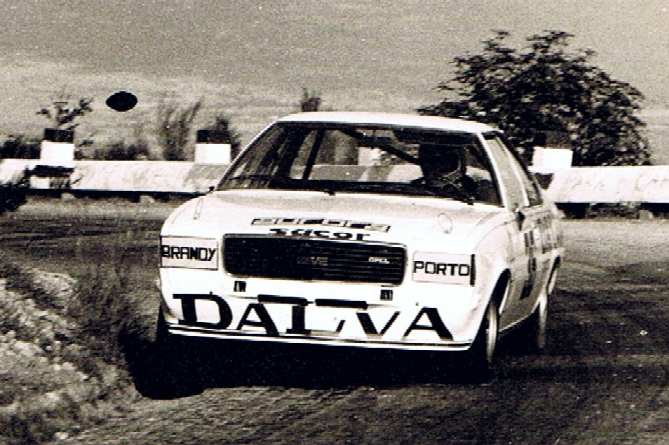
Because of this amazing initiation, Kiko raced for TEAM DALVA, with many other racing cars, like…Toyota Corolla 1200 S KE20; Opel Commodore GS/E; Mini cooper; Porsche Carrera RSR and Alfa Romeo 2000 GTV.
In 1977 on the wheel of an Alfa Romeo 2000 GTV, Kiko ran in a unlucky race, in Estoril.
Mechanical problems forced him to park the car near to the finish line, he has waited next to the rail till all competitors crossed the finish line.
"Kiko" da Silva at the wheels of an Opel Commodore GS/E 
The winner of this 500km race in Estoril was the Italian Humberto Grano driving a BMW 3.0 CSL, that because of a breakdown in the alternator was racing without lights, Humberto didn´t see the finish line flag and was still in race mode, due to this, Kiko crossed the race track and the worst happened.
A unusual accident in the national motoring.
A visionary, a friend… a great pilot.
Now recovering another tradition, C. da Silva is back to the racing tracks…

Gonçalo Devesas


Port a national symbol !

Port wine was, and is, a key product for the National economy and even more a symbolic asset that represents Port througout the world.

The designation Port wine appeared during the second half of the 17th century due to an incredible expansion of Douro viticulture and a rapid growth in wine exports.

It all began in 1680, on that time there were political diferences between the french prime minister, Colbert and King Charles II from UK.

These political diferences led both countries to the Augsburg battle in 1688, forcing the british royalty to send merchants seeking for alternative wine sources, Italy, Spain but most of all the North of Portugal.

As the brithish people´s taste started to become more sofisticated, the merchants went into the core of the Douro valley where the quality was amazing.

In 1703 the Methuen treaty, for the wine exports Portugal was paying 2/3 of the exportation fees to U.K. while on the other hand Portugal was buying the textiles from the british.

Between 1710 and 1740, the Port era, the ships departed from Porto, that was a very important seaport located in the mouth of the Douro river heading towards England and abroad.
In England there were merchants with wagons pulled by horses waiting to load the oak casks, afterwards they would go to the castles and in the private cellars or warehouses the merchants staff would made the bottling.
Port was not a nobility drink, people drank Port in the taverns with a mug directly from the casks.

Elderberry and sugar were added to wine and everyone wanted to become a grape grower, so the quality decreased.
In order to stop with a lack of both quality and territorial coordination, in 1756 the portuguese prime minister, the Marquis de Pombal, ordered the distribution of 335 milestones along 250000hects.

Nowadays there are 45700hects cultivated and 39100 grape growers, Port is strictly controlled by the Port wine Institute inspectors and thousands of chemical analysis annualy made, before each Port producer gets the bottling approval.


Gonçalo Devesas

The 2011 harvest in the demarcated Douro region

This year the harvest in the Douro valley started ten to fifteen days earlier than it is usual in the Douro valley due to a mix of both hot and semi-cold weather, that also decreased the quantity in less 30%.

The normal procedure is to start the picking of white grapes in the end of August beginning of September and one week after the red grapes, but this year the maturation process was faster.

The vines were also affected by the intense heat in the last days of June that damaged some of the more delicated grape varietals, mildew and insect attacks forced the grape growers and the producers to apply more products in order to protect the vineyards.

The three heat periods that occurred between April and May accelerated the growth cycle of the vines. Then, the temperatures in July and in the first fifteen days of August were lower allowing the plants to work faster and more constant, avoiding the water stress what will be reflected in a better quality of the Port and wine.


Worldwide crisis has been forcing the IVDP (Port wine Institute) to reduce the Port wine production.
In 2001- the maximum allowed were 145000 casks (79.500000liters) used for the "benefício" (the process of adding a distilled grape spirit in order to stop the fermentation and boost the alcohol content).
Currently for 2011 the maximum allowed is 85000 casks of wine (46.750000 liters), in about ten years there was a decrease of 45%.

Gonçalo Devesas


Drinking Port is the best choise !

When turning a bottle, we always see on the back label "contains sulfites", well the natural sulfites quantity in the wine is about 10mg/ltr.

But the producers use the sulfites in the grapes to avoid the fungus, after the fermentation process as a hygienic solution, during the claryfing process and before the bottling.

There are some producers that are trying to make only a natural wine, but it is too difficult, because the sulfites work as an anti-oxidant and wine preservative, so the wine will be very fragile and with an awful presentation without it, this is still for personal comsuption.

Per liter in a bottle of red wine we have 160mg/ltr; for white wine 260mg/ltr; untill 300mg/ltr for fortified wines like Moscatel and 400mg/ltr for a Late harvest.

According to World Healthcare Organization, it is particulary dangerous for a person with asthma.
The maximum daily quantity of sulfites is 0,7mg/ per kilo of body weight per day...ex. for a person with 70 kilos the maximum value (daily) 49mg/ltr.

In a bottle of Port there is an average of 60/70mg/ltr, (and speaking about bottles with 75cl content) so that lead us to about 45mg/ltr in a bottle of Port and saying it briefly.

In short drinking Port is the best choise...always with moderation.

One of many great experiences at C. da Silva Port & Wine shop
Gonçalo Devesas

How the Port wine grapes are rated ?

How the Port wine grapes are rated ?

# Slope gradient - vineyards planted in flat properties do not receive any points, but the vineyards planted in a slope incline with more than 35 degrees will receive a very good rating;
# Stony ground - having a lot of shale in the property is very important, for a gradual moisture; to retain more water during the winter and the contact with it will help to spread a important quantity of minerals for the vines; to maintain a constant micro-climate (during the day the shale is a rock that absorves a lot of heat and during the night will reflect the warmth to the vineyards);
# Age and quality of the vineyards/grapes - At least a Port wine vineyard must have a minimum of 5 years, but for a very good classification it starts in 26 years; also the grapes are now rated by their own characteristics;
# Planting density - Per hectare a huge vineyard plantation is very good to avoid the "vineyard stress", but for Port wine is very good between 4500 vines till 5000 vines, with a quantity in liters 3000ltrs (average) and 5500ltrs (maximum allowed per hectare) this allows less quantity but better quality;
# Protection - Narrow Valley locations and river estuaries are very important because while protecting the vineyards from the strong and cold winds, it can be hotter than the higher places (slopes top);
# Exposition - In the cooler areas it is very important a good southern exposure, of course that for the hotter areas it´s a handicap. Depending on the weather conditions, there is a ability (a great one, nowadays) for a 2nd pruning level (on the leafs and during the spring and summer), because the grapes need to be protected by the direct sun, but at the same time they need to receive enough sunlight and warmth for fotosynthesis and nutrients.

Unloading the Port wine grapes in C. da Silva vinification center


Rating:

A >1200 points

B between 1001 and 1200 points

C between 801 and 1000 points

D between 601 and 800 points

E between 401 and 600 points

F between 201 and 400 points

A and B quality are the one´s used in the Vintage Port, Vintage Port represents in average less than 2% of each Port wine Company´s annual production.

Gonçalo Devesas